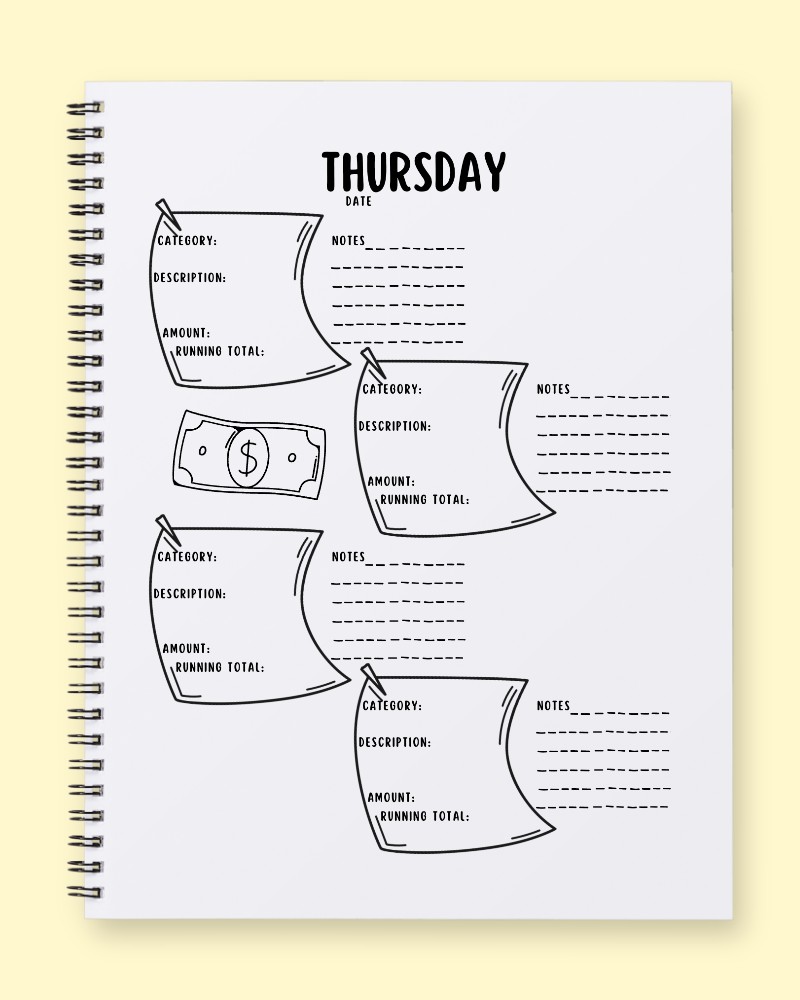
Managing your money doesn't have to be a daunting task. With the Daily Receipt & Expense Tracker with Notes, you gain a powerful, visually engaging tool designed to bring clarity and intention to your financial habits, day by day. This unique journal page template, perfectly suited for a spiral-bound notebook, transforms the mundane act of logging expenses into a mindful practice. Featuring dedicated "receipt-style" blocks for categorizing and describing transactions, along with a crucial "running total" and adjacent "notes" sections, it’s more than just a ledger—it's your daily financial coach in paper form. Whether you're tracking daily spending, managing a specific budget, or simply aiming for greater financial awareness, this personal finance journal provides the structure you need with a touch of charming simplicity.
The Psychological Benefits of Using This Specific Tracker
This isn't just another generic budget planner; its specific design offers distinct psychological advantages for anyone seeking to master their finances. The "receipt-style" blocks inherently make each transaction feel like a tangible event, rather than a fleeting digital entry. This visual separation helps reduce cognitive overload, making the act of tracking feel less overwhelming and more like filing individual records. The inclusion of a "RUNNING TOTAL" is a critical feature, actively encouraging you to calculate the immediate impact of your spending. This consistent, real-time calculation fosters a heightened sense of financial awareness, preventing "budget amnesia" and allowing you to see your remaining funds (or total spent) at a glance.
Furthermore, the dedicated "NOTES" section adjacent to each expense entry is a game-changer for mindful spending. It moves beyond just logging numbers, inviting reflection on the why behind a purchase, the emotions involved, or future considerations. This qualitative data transforms a simple spending log into a rich source of insight into your spending patterns, triggers, and values. Physically writing down your transactions and reflections enhances memory retention and creates a deeper, more personal connection to your money. This tangible engagement with your daily money management cultivates a powerful sense of control and reduces anxiety often associated with personal finance, making the journey toward financial wellness more approachable and less intimidating.
A Step-by-Step Guide on How to Fill It Out Effectively
Utilizing your Daily Receipt & Expense Tracker effectively is straightforward and highly impactful:
- Set the Stage (Top Header): Begin by writing "THURSDAY" (or the appropriate day) and the specific "DATE" at the top of the page. If you're tracking cash flow or a daily allowance, consider writing your starting balance for the day at the very top or in the notes section.
- Log Each Transaction (Receipt Block): As you make a purchase or receive income, grab your journal and find the next available "receipt-style" block.
- CATEGORY: Be specific. Instead of just "Food," write "Groceries," "Dining Out," or "Coffee."
- DESCRIPTION: Provide details. "Starbucks" is good, "Latte & Muffin at Starbucks" is better.
- AMOUNT: Accurately record the monetary value of the transaction.
- RUNNING TOTAL: This is crucial! Calculate your new balance after this transaction. If you started with an initial daily budget, subtract expenses to find your remaining funds. If you're just tracking outgoing expenses, add this amount to your cumulative spending for the day. This provides instant feedback on your financial position.
- Harness the "NOTES" Section: Immediately after logging a transaction, use the adjacent "NOTES" lines. This is where the true insights lie.
- Why did I buy this? (e.g., "Impulse buy," "Planned necessity," "Birthday gift for friend")
- How does this make me feel? (e.g., "Regretful," "Satisfied," "Excited")
- Any thoughts for the future? (e.g., "Bring lunch tomorrow," "Need to save for this," "Glad I budgeted for it")
- Repeat & Reflect: Continue this process for all your daily financial activities. The layout provides ample space for four distinct tracking events, each with its dedicated reflection area. At the end of Thursday, take a few minutes to review your entire page. Look at your categories, descriptions, and especially your notes. What patterns emerge?
Three Daily Prompts That Pair Well With This Layout
To maximize the benefits of your daily expense tracking notebook, integrate these prompts into your routine, using the "NOTES" sections for reflection:
- Morning Focus (Pre-spending): Before your day truly begins, reflect: "What are my primary financial intentions for today? Is there one spending category I want to be particularly mindful of, and why?" Use the top "NOTES" section or the first transaction's notes to outline your proactive financial mindset for the day.
- Mid-Day Check-in (Post-transaction Reflection): After making one of your first purchases, use its adjacent "NOTES" section to ask: "Beyond the necessity, what value did this purchase bring to my day? Was it aligned with my financial goals, or was it a moment of indulgence? How do I feel about it now?" This encourages immediate, specific introspection.
- Evening Synthesis (Daily Review): As you complete your final transaction for the day or before going to bed, review all your entries. In one of the larger "NOTES" sections or a blank space at the bottom: "Looking at today's spending, what's the most significant insight I gained about my money habits? What's one small, actionable step I can take tomorrow to improve my financial wellness?" This prompt consolidates daily learning into future action, reinforcing positive habits.
By diligently using your Daily Receipt & Expense Tracker with Notes, you're not just tracking money; you're building a healthier, more conscious relationship with your finances, one Thursday at a time.