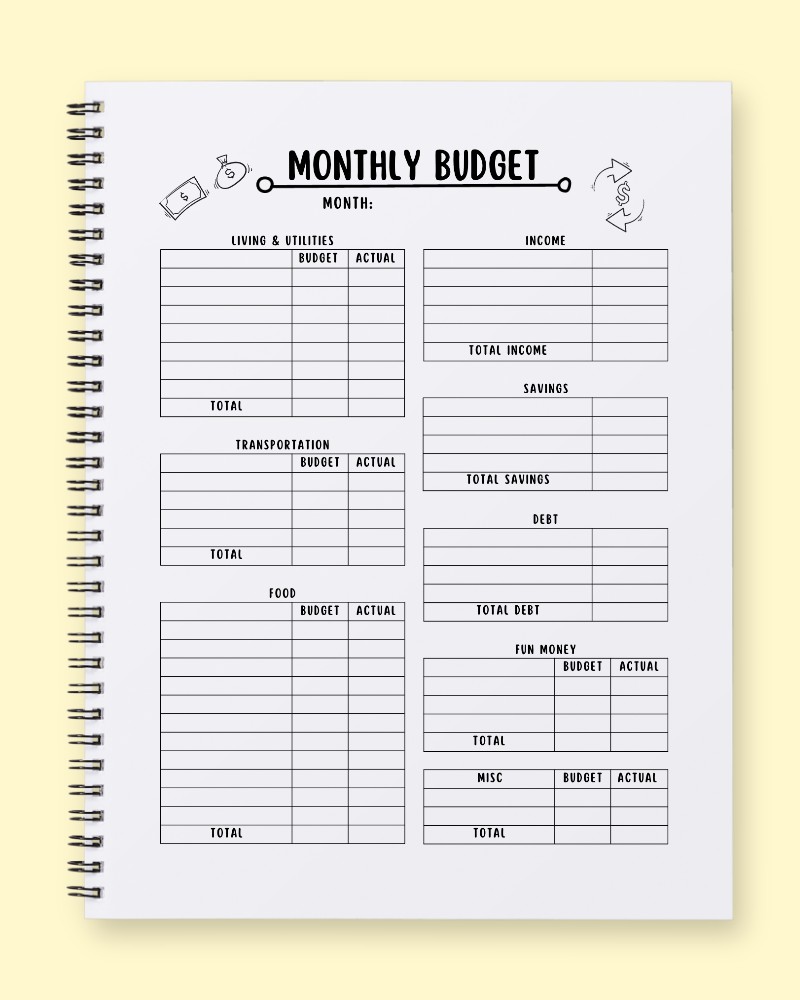
Managing your finances can often feel overwhelming, but with the right tools, it transforms into an empowering journey toward financial freedom. This beautifully designed Monthly Budget Planner template isn't just a ledger; it's a strategic partner in your personal finance journey. Ideal for anyone seeking clarity, control, and consistent progress in their money management, this budget worksheet provides a clean, categorized, and intuitive layout to track every dollar.
The Psychological Edge: Why This Planner Empowers You
This specific monthly budget planner isn't just about numbers; it's a powerful psychological tool designed to foster healthy financial habits and reduce stress. The clear "BUDGET" and "ACTUAL" columns side-by-side create an immediate visual comparison, a technique proven to boost self-awareness and accountability. This direct feedback loop helps you identify spending leaks in categories like "LIVING & UTILITIES," "TRANSPORTATION," and "FOOD," transforming vague financial anxiety into actionable insights. By physically writing down your intentions and then your realities, you engage a different part of your brain than digital tracking, often leading to better memory retention and commitment.
The dedicated sections for "INCOME," "SAVINGS," and "DEBT" are more than just placeholders; they're anchors for your financial goals. Visually seeing your planned savings contributions and debt payments reinforces your commitment, turning abstract aspirations into tangible steps. Even the inclusion of "FUN MONEY" is a psychological win, legitimizing discretionary spending within limits and preventing feelings of deprivation that often sabotage budgeting efforts. This structured approach, combined with the act of manually filling it out, instills a sense of control and mastery over your money, leading to reduced financial stress and increased confidence in your financial future. It turns the daunting task of financial planning into a manageable, rewarding routine.
Your Step-by-Step Guide to Effective Budgeting
Unlock the full potential of your Smart Spend Monthly Budget Planner with this straightforward guide:
- Set Your Stage: Begin by filling in the "MONTH:" field at the very top. This clearly defines your budgeting period and keeps you organized.
- Map Your Income: Move to the "INCOME" section on the right. List all expected income sources for the month, such as your "Salary," "Freelance Work," or "Side Hustle." Sum these up and write the grand total in the "TOTAL INCOME" box. This is your foundation.
- Plan Your Spending (The Budget Column): Now, for the proactive part. Go through each expense category: "LIVING & UTILITIES," "TRANSPORTATION," "FOOD," "FUN MONEY," and "MISC." For each line within these categories, write down your estimated expenditure for the month. Be honest and realistic about how much you plan to spend. For instance, under "LIVING & UTILITIES," you might list "Rent," "Electricity," "Internet." Calculate the total for each category and write it in the respective "TOTAL" line beneath it.
- Prioritize Savings & Debt: Dedicate attention to the "SAVINGS" and "DEBT" sections. List your planned contributions to savings (e.g., "Emergency Fund," "Retirement," "Vacation") and record the sum in "TOTAL SAVINGS." Do the same for all your "DEBT" payments (e.g., "Credit Card," "Student Loan," "Car Payment"), tallying them in "TOTAL DEBT."
- Track Your Reality (The Actual Column): As the month progresses, diligently record every single expense in the "ACTUAL" column, aligning it with your budgeted items. This is where you track your real-world spending. If an expense arises that wasn't budgeted, add it to the most relevant category.
- Calculate Actual Totals: At the end of the month, or even weekly, sum up all your "ACTUAL" expenditures for each category and write these totals in the "TOTAL" lines provided. Do this for "FUN MONEY" and "MISC" as well.
- Review and Adjust: This is the most crucial step. Compare your "BUDGET" column with your "ACTUAL" column. Identify areas where you overspent or underspent. This comparison is vital for understanding your habits and making informed financial adjustments for the next month.
Daily Prompts to Enhance Your Budgeting Journey
To deepen your engagement with this financial tracker and transform it into a powerful personal finance tool, integrate these daily reflection prompts:
- End-of-Day/Week Review: "Reflecting on my 'ACTUAL' spending today/this week, in which specific category (e.g., 'FOOD' or 'TRANSPORTATION') did I deviate most from my 'BUDGET'? What conscious choice or unforeseen event led to this difference, and what can I learn for tomorrow?"
- Pre-Purchase Mindfulness: "Before making this next purchase, does it align with an item I've already allocated in my 'BUDGET' column for 'FUN MONEY' or another specific category? If not, is this a necessary expense, and where can I adjust my planned spending elsewhere to accommodate it without derailing my overall monthly financial goals?"
- Goal Reinforcement: "How did my financial choices today contribute, even in a small way, to increasing my 'TOTAL SAVINGS' or reducing my 'TOTAL DEBT' as outlined in my monthly plan? What is one actionable step I can take tomorrow to reinforce these long-term financial goals and see those numbers improve further?"
Explore Our Resources
Explore free printable planners, journals, and trackers to stay organized, build better habits, and simplify your daily routine. Practical tools and guides designed for real life.