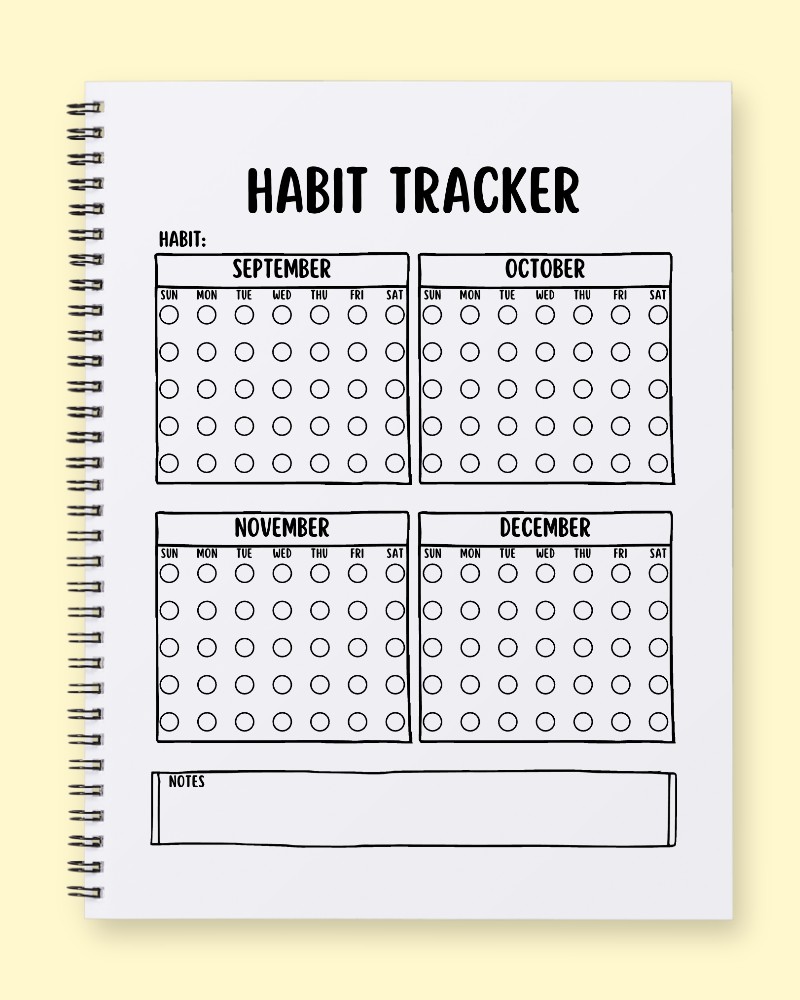
Unlock unparalleled productivity and personal growth during the crucial last quarter of the year with this meticulously designed Q4 Habit Tracker Template. Far more than just a simple checklist, this journal page offers a structured, visual, and psychologically informed approach to habit formation from September through December. By providing dedicated monthly grids and a vital notes section, it transforms abstract intentions into concrete, trackable progress, setting you up for a strong finish to the year and an even stronger start to the next.
1. The Psychological Benefits of This Specific Tracker Layout
This particular habit tracker template is engineered to leverage several key psychological principles, fostering lasting behavioral change. Firstly, the clear, dedicated "HABIT:" line at the top provides immense mental clarity. By committing to tracking just one core habit per page, you eliminate decision fatigue and cognitive overload, making it easier to focus your energy and build a solid foundation. This singular focus adheres to the principle of "one thing at a time," significantly increasing the likelihood of success.
Secondly, the visual layout of four distinct monthly grids (September, October, November, December), each with individual circles for daily tracking, offers powerful feedback loops. Seeing a continuous line of filled circles creates a strong sense of achievement and momentum, triggering the brain's reward system and reinforcing the desired behavior. Conversely, observing blank circles serves as a gentle, non-judgmental nudge for accountability, prompting reflection rather than guilt. The sequential nature of the months encourages a long-term perspective, allowing you to observe trends, overcome plateaus, and maintain consistency over a significant 120-day period. This extended view helps users internalize the habit, moving beyond transient motivation to deeply ingrained routine.
Finally, the inclusion of a prominent "NOTES" section at the bottom is a game-changer for metacognition and adaptability. This dedicated space transforms the tracker from a mere record-keeping tool into a dynamic learning journal. Psychologically, journaling about your habit journey helps process challenges, celebrate victories, and identify triggers or obstacles. It facilitates self-awareness, allowing you to fine-tune your approach based on real-world experience, ensuring that your habit formation strategy is not static but evolves with your personal circumstances.
2. A Step-by-Step Guide on How to Fill It Out Effectively
Utilizing this Q4 Habit Tracker Template to its fullest potential requires a systematic approach. Follow these steps for maximum effectiveness:
- Define Your Q4 Habit (Top Line): Begin by clearly writing down one specific, measurable habit you intend to cultivate or maintain for the entire last quarter. For example, instead of "Exercise," write "30 mins walking daily" or "Drink 2L water." The "HABIT:" line is designed for this singular focus.
- Familiarize with Monthly Grids: Observe the four distinct sections for September, October, November, and December. Each grid features days of the week (SUN-SAT) across the top and five rows of circles below. These circles represent the days of the month, accommodating up to 35 days, ensuring every day is covered regardless of the month's length or starting day.
- Daily Tracking Ritual: At the end of each day, if you successfully completed your chosen habit, fill in the corresponding circle for that specific day within the correct month's grid. You can use a solid mark, a checkmark, or color it in – whatever visually motivates you most. If you miss a day, intentionally leave the circle blank. Resist the urge to retroactively fill in missed days; honesty with yourself is crucial for accurate self-assessment.
- Leverage the Notes Section (Crucial for Learning): The "NOTES" section isn't just for miscellaneous thoughts. Use it strategically. At the end of each week or month, or whenever a significant insight occurs, jot down observations. Examples: "Sept Week 2: Mornings are hard for this habit, need to adjust wake-up time," "Oct 15: Felt incredibly energetic after completing the habit today," "Nov 10: Travel disrupted my routine – need a plan for consistency on trips," "Dec 31: Celebrated 90% completion, ready for next year's habit!" This makes your tracking an active learning process.
- Quarterly Review: Once December is complete, take time to review all four monthly grids and your notes. Analyze streaks, identify patterns, understand your triggers for success and failure, and celebrate your progress. This comprehensive overview provides invaluable data for refining your self-improvement strategies moving forward.
3. Three Daily Prompts That Pair Well with This Layout
To deepen your engagement and maximize the insights gained from this specific tracker layout, integrate these daily prompts into your routine, often utilizing the "NOTES" section:
- "Before I fill today's circle, what 'mini-win' did I achieve related to this habit today, or what micro-step will guarantee its completion?" This prompt encourages proactive planning and positive reinforcement. By focusing on a "mini-win" or a guaranteed micro-step, you empower yourself to consistently mark those daily circles, transforming intention into action within the monthly grids. Use the 'NOTES' section periodically to list these mini-wins for review.
- "Looking at this week's progress in the current month's grid, what is one challenge I faced or one strategy that worked exceptionally well? Briefly record it in the 'NOTES' section." This prompt directly connects your visual progress on the monthly grid with reflective journaling. It encourages you to analyze both successes and setbacks, using the dedicated "NOTES" area to document actionable insights that can be applied to future days or months within the same Q4 period.
- "If I've been consistent today, how does my physical or mental state feel different compared to days I've missed? If I missed, what one adjustment can I make tomorrow to get back on track?" This prompt fosters a deep connection between your actions (filling or leaving circles blank) and their tangible impact. It encourages self-awareness by prompting a comparison of states, reinforcing the positive outcomes of consistency, and immediately identifying a small, actionable step for recovery, making the visual data in the monthly grids more meaningful.