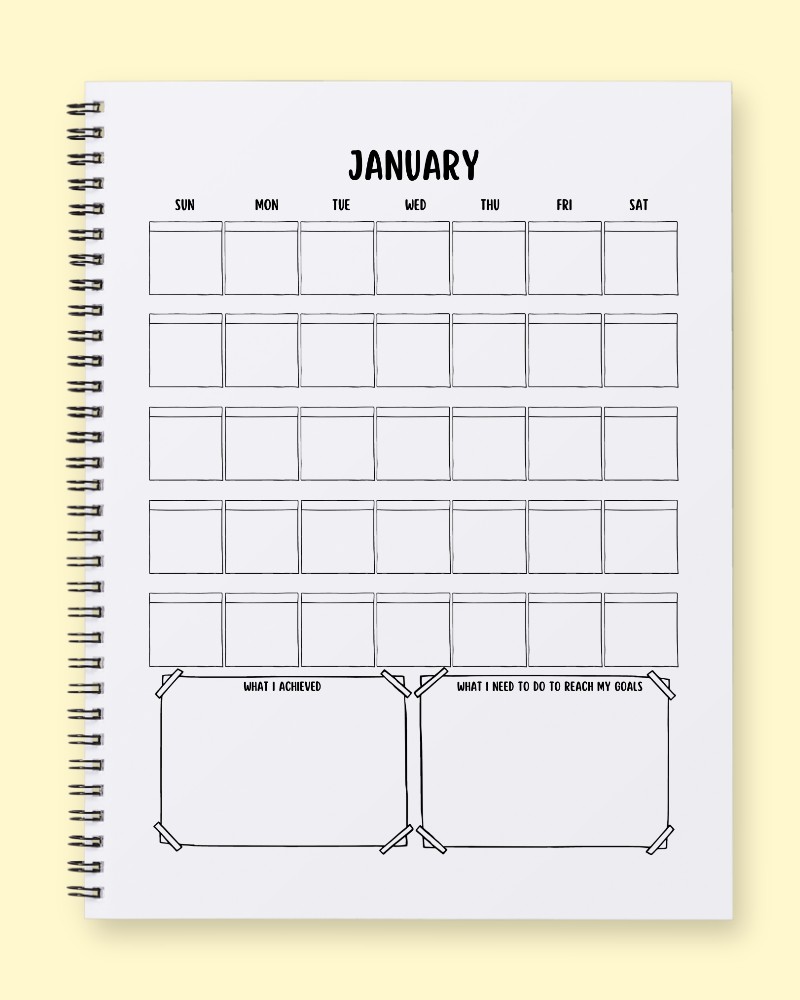
Unleash your potential and foster intentional growth with our January Monthly Progress & Reflection Planner. This intuitive journal page is more than just a calendar; it's a powerful tool designed to help you track daily habits, celebrate achievements, and strategically plan your path forward. Ideal for students, professionals, and anyone committed to personal development, this template transforms abstract goals into actionable steps and tangible victories.
1. The Psychological Benefits of Using This Specific Tracker/Planner
This unique layout offers profound psychological advantages, meticulously crafted to boost motivation, clarity, and self-efficacy. The prominent monthly calendar grid provides a visual representation of your entire month at a glance. Daily check-ins within these individual boxes foster a strong sense of accountability and consistency, crucial for habit formation. Seeing a chain of completed tasks or marked habits offers immediate positive reinforcement, combating procrastination and building momentum. It helps reduce overwhelm by breaking down larger goals into manageable daily components, making progress feel achievable rather than daunting.
Below the daily tracker, the two distinct framed sections — "WHAT I ACHIEVED" and "WHAT I NEED TO DO TO REACH MY GOALS" — are psychological powerhouses. The "WHAT I ACHIEVED" box encourages a vital practice of self-reflection and gratitude. By consciously documenting successes, big or small, you actively combat imposter syndrome and foster a positive self-image. This act of acknowledging progress reinforces your capability and competence, serving as a powerful motivator for future endeavors. It shifts focus from what's lacking to what has been accomplished, cultivating a growth mindset.
Conversely, the "WHAT I NEED TO DO TO REACH MY GOALS" section is designed for proactive planning and clarity. This space helps translate aspirations into concrete action items, directly addressing potential roadblocks or next steps. It removes ambiguity, providing a clear roadmap and reducing decision fatigue. By compartmentalizing achievements and future actions, this planner promotes a balanced perspective: celebrating past efforts while maintaining a forward-looking, strategic approach. This holistic view enhances emotional well-being, reduces stress, and keeps you aligned with your long-term objectives.
2. A Step-by-Step Guide on How to Fill It Out Effectively
Utilizing this January planner template effectively is straightforward and highly impactful:
- Set the Stage: Begin by identifying the current month. The template conveniently displays "JANUARY," ready for your planning.
- Date the Calendar: Starting from the correct day of the week for January 1st, sequentially number each daily box until the month concludes. For example, if January 1st falls on a Wednesday, you’d write '1' in the 'WED' column's first box, '2' in 'THU', and so on. Fill in all 31 days.
- Daily Tracking (Calendar Grid): Each day, use the small box to track a key habit, a major task completed, or a daily reflection. You can use simple symbols (e.g., a checkmark for exercise, a star for a completed project, an 'X' for studying), or a single keyword. The goal is quick, visual logging of progress or focus for that specific day. This daily engagement builds consistency.
- Reflect on Achievements ("WHAT I ACHIEVED"): At the end of each week or the end of the month, dedicate time to reflect. Review your daily entries in the calendar grid. What significant milestones did you hit? What challenges did you overcome? What small victories added up? Write these down in detail in this section. Be specific – "Completed final project proposal," "Maintained daily meditation for 20 days," "Learned a new skill."
- Plan Future Actions ("WHAT I NEED TO DO TO REACH MY GOALS"): After acknowledging your achievements, shift your focus forward. Based on your progress, remaining goals, and any lessons learned, list actionable steps for the upcoming period. Break down larger goals into smaller, manageable tasks. For instance, if a goal is "Run a marathon," this section might contain "Research training plans," "Buy new running shoes," "Schedule first long run." These should be clear, concise, and executable.
3. Three Daily Prompts That Pair Well With This Layout
These prompts are designed to encourage deeper engagement with the specific elements of this journal page:
- For Daily Tracking: "What one essential task or habit will I intentionally focus on today, and how will I visibly mark its completion in my calendar grid?" (This prompts daily commitment and reinforces the visual tracking.)
- For Achievements Reflection: "Looking back at the past few days' calendar entries, what specific action or effort truly stands out as an achievement, no matter how small, and what positive impact did it have on my overall progress or mood?" (This encourages acknowledging small wins and connects directly to the "WHAT I ACHIEVED" section.)
- For Future Planning: "Considering my overarching goals and today's progress, what is the single most important, next concrete step I can list in the 'WHAT I NEED TO DO' section to move me closer to my objectives?" (This drives actionable planning and utilizes the "WHAT I NEED TO DO" box effectively.)