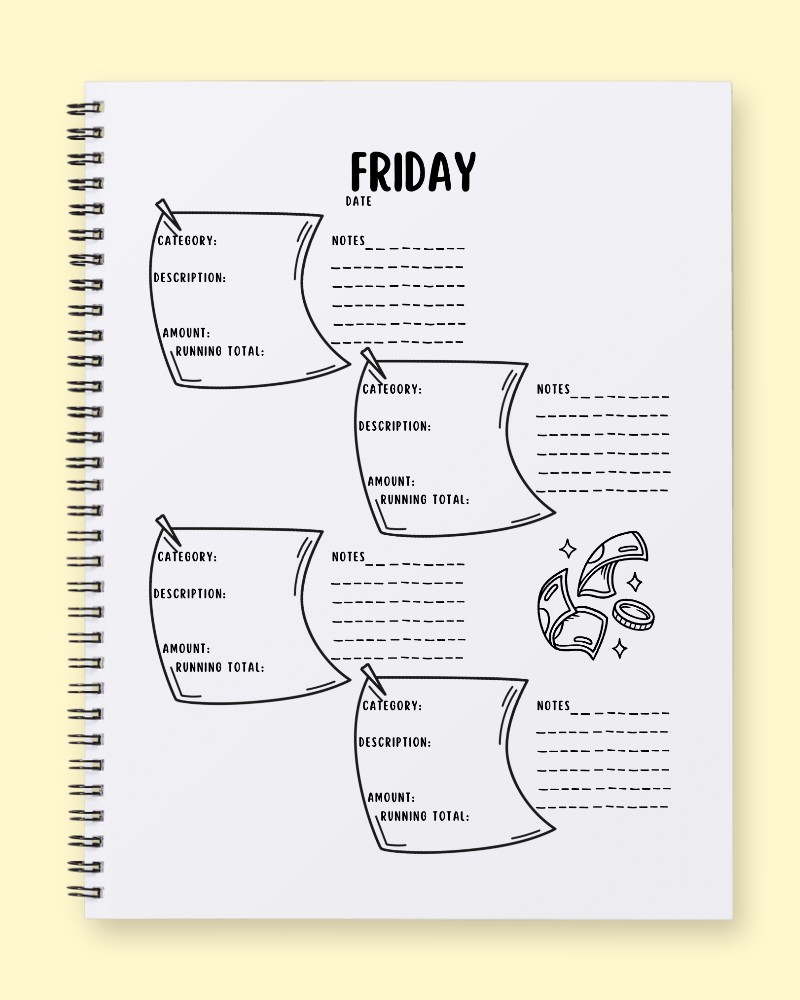
Managing personal finances can often feel like a daunting task, but with the right tools, it transforms into an empowering journey of awareness and control. Introducing a meticulously designed daily expense tracker and budget planner page, specifically crafted to simplify your financial tracking on a day-by-day basis. This printable template, featuring a charming hand-drawn, receipt-like aesthetic, is more than just a place to jot down numbers; it's a dedicated space for mindful money management, tailored for tracking expenses, incomes, and reflections on your spending habits. With clear sections for categories, descriptions, amounts, running totals, and personal notes, it offers a holistic view of your financial flow, turning abstract figures into tangible insights.
1. The Psychological Benefits of Using This Specific Tracker/Planner
This unique daily tracker goes beyond simple record-keeping, offering profound psychological advantages for anyone striving for better financial health. The "receipt-like" visual layout makes tracking feel less like a chore and more like organizing your daily financial "receipts," making the process engaging and less intimidating than a spreadsheet. The continuous "Running Total" feature is a powerful anxiety reducer; it provides immediate, real-time feedback on your current financial standing after each transaction. This instant clarity replaces uncertainty with a sense of control, helping you visualize your money's movement throughout the day. Furthermore, the dedicated "Notes" section beside each transaction encourages mindful spending and reflection. Instead of just logging a number, you're invited to ponder the why behind a purchase or the feeling associated with an income, fostering a deeper connection to your financial decisions. This practice cultivates greater financial awareness, reduces impulse spending, and builds confidence in your money management skills, ultimately leading to a sense of accomplishment and reduced financial stress.
2. A Step-by-Step Guide on How to Fill It Out Effectively
Maximize the potential of your daily expense tracker with this simple, yet powerful, step-by-step approach:
- Set the Date: Begin by filling in the specific date at the top, right below "FRIDAY." This ensures your records are chronologically accurate.
- Record Each Transaction: For every financial activity—whether it's an expense or an income—dedicate one of the four "receipt" sections to it. Aim to record transactions as they happen or at least once a day.
- Categorize Clearly: In the "CATEGORY:" field, assign a relevant spending category (e.g., Groceries, Transport, Entertainment, Utilities, Income, Savings). This helps you identify where your money is going at a glance.
- Detail the Description: Use the "DESCRIPTION:" line to briefly explain what the transaction was for (e.g., "Morning coffee," "Bus fare to work," "Online book purchase," "Freelance payment"). Specificity here will prove invaluable later.
- Input the Amount: Accurately write down the monetary value in the "AMOUNT:" field. Remember to indicate if it's an expense (e.g., -$5.00) or income (e.g., +$50.00).
- Update the Running Total: This is the heart of the tracker. Start with your opening balance for the day (or your previous running total). After each transaction, update the "RUNNING TOTAL:" to reflect your new balance. This immediate update keeps you fully aware of your financial position.
- Utilize the Notes Section: Don't skip the "NOTES" area next to each receipt. This is your personal space for observations. Did you feel good about this purchase? Was it an impulse buy? Is this a recurring expense you want to reduce? Jot down any thoughts, feelings, or future actions related to the transaction.
3. Three Daily Prompts That Pair Well With This Layout
To further enhance your financial reflection and planning, integrate these prompts into your daily routine, leveraging the tracker's specific layout:
- "Reviewing today’s 'Running Total' progression, what surprised me most about my spending habits, and what specific change could I make tomorrow?" This prompt encourages you to analyze the immediate impact of your transactions shown by the running total and identify concrete steps for improvement, directly linking to the core functionality of the tracker.
- "Did any of my 'Notes' reveal a purchase that perfectly aligned with my values or a goal? Conversely, was there one that felt out of sync? Elaborate on the 'why' for both." This prompt deepens the reflective aspect, pushing you beyond mere numbers to connect your spending with your personal values and aspirations, making full use of the "Description" and "Notes" sections for qualitative insights.
- "If I could reallocate one 'AMOUNT' spent today, which one would it be and where would I move that money to better serve my financial future (e.g., savings, debt repayment, investment)? Write down the new category and description." This prompt fosters proactive financial planning and critical thinking, encouraging you to consider alternative uses for your funds, utilizing the "Category," "Description," and "Amount" fields in a hypothetical, forward-looking exercise.