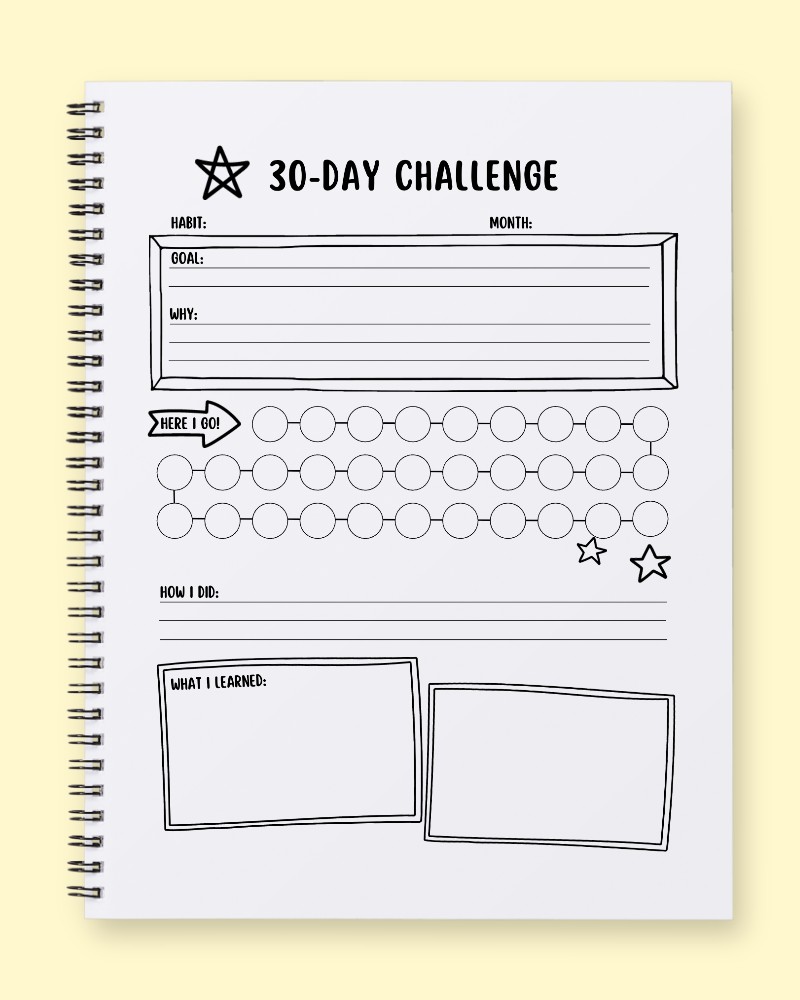
Unlock your full potential and cultivate lasting habits with our innovative 30-Day Challenge Tracker. Designed for clarity, motivation, and profound personal growth, this template transforms abstract goals into actionable, measurable progress. Whether you're aiming to drink more water, meditate daily, or learn a new skill, our tracker provides the structured support you need to succeed. Embrace the power of consistent action and mindful reflection with this essential tool for self-improvement and productivity.
The Psychological Benefits of Your 30-Day Challenge Tracker
This isn't just a blank page; it's a carefully crafted psychological tool. The visual elements of this specific layout are designed to tap into cognitive biases and behavioral science, maximizing your chances of success.
- Visual Momentum and Reward System: The clear sequence of 30 circles, initiated by the "HERE I GO!" arrow, provides an immediate, visual representation of progress. Each filled circle acts as a mini-reward, triggering dopamine release and reinforcing the habit loop. This gamified approach makes the process feel less like a chore and more like a game you're winning, encouraging continued engagement. The two larger stars at the end offer a bonus visual milestone, perhaps for celebrating completion or reaching an extra goal.
- Clarity of Purpose and Intrinsic Motivation: The dedicated "HABIT," "GOAL," and "WHY" sections are critical. By explicitly writing down your habit, the overarching goal it supports, and the deep-seated reasons why it matters to you, you forge a strong mental link between daily action and long-term fulfillment. This clarity shifts motivation from external pressure to internal desire, making you more resilient against setbacks.
- Enhanced Self-Awareness Through Reflection: The "HOW I DID" and "WHAT I LEARNED" sections move beyond simple tracking to foster metacognition. These prompts encourage you to analyze your daily performance, identify patterns, pinpoint challenges, and strategize solutions. This reflective practice turns potential failures into valuable learning opportunities, building resilience and making your habit-forming journey more intelligent and adaptable.
- Reduced Overwhelm and Increased Focus: Breaking a large goal into a 30-day segment, each represented by a single circle, makes the task less daunting. Focusing solely on completing today's circle simplifies decision-making and reduces cognitive load, allowing you to channel energy directly into the habit itself. The single page layout also keeps all relevant information for the challenge in one easily accessible place.
A Step-by-Step Guide to Filling Out Your Tracker Effectively
To harness the full power of this 30-day challenge template, follow these specific steps:
- Define Your Core Habit (HABIT): In the "HABIT" line, write down one specific, actionable habit you want to cultivate. Make it clear and concise. Examples: "Read for 30 minutes," "Drink 2 liters of water," "Meditate for 10 minutes."
- Set Your Overarching Goal (GOAL): In the "GOAL" lines, articulate what you aim to achieve by consistently performing this habit for 30 days. This should be a measurable outcome. Example: "Consistently read a chapter of a book daily for 30 days to finish 'The Power of Habit'."
- Uncover Your Deep Why (WHY): This is your anchor. Use the "WHY" lines to detail the deeper reasons behind your goal. How will this habit positively impact your life, health, or personal growth? Example: "To expand my knowledge, reduce screen time, and foster a lifelong love of learning."
- Initiate and Track Daily Progress (HERE I GO! & Circles): On Day 1, write the current month in the "MONTH:" field. As you successfully complete your habit each day, fill in one of the 30 circles, starting from the "HERE I GO!" arrow. Use a checkmark, a solid fill, or even a small drawing to make it visually satisfying.
- Reflect on Daily Performance (HOW I DID): At the end of each day (or immediately after performing the habit), use the "HOW I DID" lines to make a brief note. This isn't just about completion; it's about observation. Did it feel easy or challenging? What obstacles arose? What helped you succeed? Be honest, not judgmental.
- Synthesize Your Learning (WHAT I LEARNED): Use the two larger boxes labeled "WHAT I LEARNED" for deeper, periodic reflection (e.g., weekly or at the end of the 30 days). Summarize key insights: What strategies worked best? What patterns did you notice? How has the habit impacted you? What adjustments might be necessary for future challenges?
Three Daily Prompts That Pair Well With This Layout
To maximize your self-awareness and commitment, integrate these specific prompts with your daily tracking:
- Pre-Habit Intention Setter (Morning/Before Action): Before you fill in your circle for the day, ask yourself: "What single, focused action will I take today to ensure I successfully complete my habit?" Writing this down mentally or briefly in the "HOW I DID" section sets a clear intention and primes you for success.
- Mid-Day Obstacle Overcomer (Anytime during the day): If you're struggling or faced a challenge with your habit today, use this prompt: "What was the biggest hurdle I encountered today regarding my habit, and what is one small thing I can do right now or tomorrow to address it?" This proactive reflection helps populate your "HOW I DID" section with actionable insights.
- Post-Habit Gratitude & Growth (Evening/After Action): After successfully filling a circle, ask: "Beyond just completing the task, how did my body, mind, or mood feel different after engaging in my habit today?" This encourages you to connect the habit to tangible positive outcomes, reinforcing your "WHY" and providing rich content for your "WHAT I LEARNED" boxes.
Explore Our Resources
Explore free printable planners, journals, and trackers to stay organized, build better habits, and simplify your daily routine. Practical tools and guides designed for real life.